Congenital Muscular Dystrophy (CMD)
Congenital Muscular Dystrophy (CMD)
-
Duration
1- Year
-
Approved Seats
60
-
Course Type
Professional Course
Course Description
What is CMD?
Congenital Muscular Dystrophy (CMD) is a group of inherited muscle disorders present at birth or early infancy, characterized by muscle weakness and hypotonia (low muscle tone).
-
“Congenital” means present from birth.
-
“Muscular dystrophy” means progressive weakness of muscles due to genetic mutations affecting muscle proteins.
CMD affects voluntary muscles used for movement, posture, and sometimes other organs like the brain or eyes.
???? Causes
CMD is caused by genetic mutations affecting proteins responsible for muscle structure and function.
-
Most forms are autosomal recessive (both parents carry a gene).
-
Mutations affect proteins like laminin, merosin, collagen, or dystroglycan.
-
Can be detected by genetic testing.
???? Symptoms
Symptoms usually appear at birth or in early infancy and may include:
-
Weak muscle tone (hypotonia)
-
Delayed motor milestones (sitting, crawling, walking)
-
Weakness in arms and legs
-
Joint contractures or stiffness
-
Sometimes, respiratory or heart problems
-
Some forms may also have brain or eye involvement
???? Diagnosis
Diagnosis involves a combination of:
-
Clinical examination – observing muscle weakness and developmental delay
-
Creatine kinase (CK) blood test – elevated CK indicates muscle damage
-
Muscle biopsy – examines muscle tissue structure
-
Genetic testing – identifies the specific mutation
-
MRI / imaging – can assess brain or muscle abnormalities in certain CMD types
???? Types of CMD
Some common types include:
-
Merosin-deficient CMD (MDC1A) – most common; affects laminin protein
-
Ullrich CMD – joint contractures and loose joints
-
Alpha-dystroglycan-related CMD – can involve the brain
-
Rigid Spine CMD – affects spine mobility and posture
????️♂️ Management / Treatment
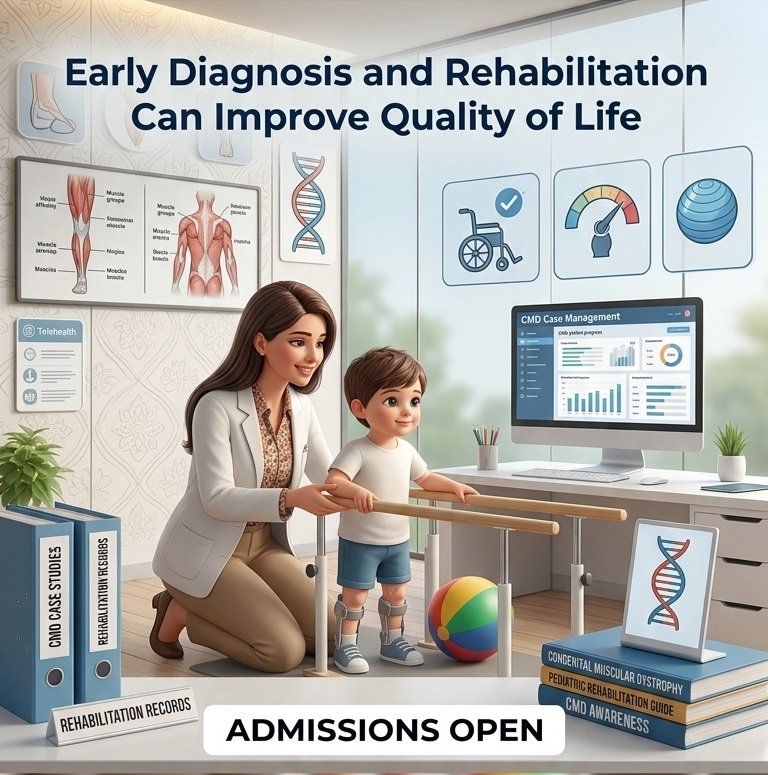
There is no cure for CMD yet. Treatment focuses on symptom management and improving quality of life:
-
Physiotherapy – maintain muscle strength and flexibility
-
Occupational therapy – assist with daily activities
-
Respiratory support – ventilators if needed
-
Orthopedic interventions – braces, surgeries for contractures
-
Cardiac and neurologic care – monitor heart and brain involvement
-
Genetic counseling – for families planning future children
???? Prognosis
-
Depends on type of CMD and severity
-
Some types have slow progression, allowing mobility into adulthood
-
Others may cause severe muscle weakness and respiratory issues early in life
Eligibility / Requirement
-
Minimum Qualification
10+2 or equivalent from recognized board.
-
Interest in Field
Students interested in professional career development.
Career Opportunities
-
Government Jobs
Opportunities in public sector organizations.
-
Private Sector
Career opportunities in private companies.
-
Higher Studies
Students can pursue advanced studies in related fields.
Admission Open
Course Information
-
Duration
1- Year -
Seats
60 -
Language
English / Hindi -
Certificate
Yes
Flexibility
You can study anytime anywhere
Lower Costs
Our Courses are more affordable
Documentation
All the details will be safely stored